The Breed
The vizsla is a breed of sporting dog developed in Hungary and regarded as one of the oldest of the Continental pointing breeds. Its recorded history spans some eleven centuries, from the hunting dogs of the Magyar tribes to established breeding programs in Australia. Bred for centuries by the Magyar nobility to hunt, point and retrieve game on the open plains of the Carpathian Basin, it is distinguished by a short golden-rust coat, an elegant yet powerfully athletic frame, and a famously affectionate, people-oriented temperament.
One of the versatile, or hunt-point-retrieve (HPR), breeds, the vizsla is a single dog expected to find, point, track and retrieve game on land and in water. The Fédération Cynologique Internationale classifies it in Group 7 under Standard No. 57; the American Kennel Club places it in the Sporting Group, and Dogs Australia in Group 3, Gundogs.
Its self-coloured golden-rust coat — nose, eye rims, lips and nails all blending into the same tone — and its lean, athletic build are the breed's signature. It is a devoted companion breed, deeply attached to its people and happiest working alongside them.
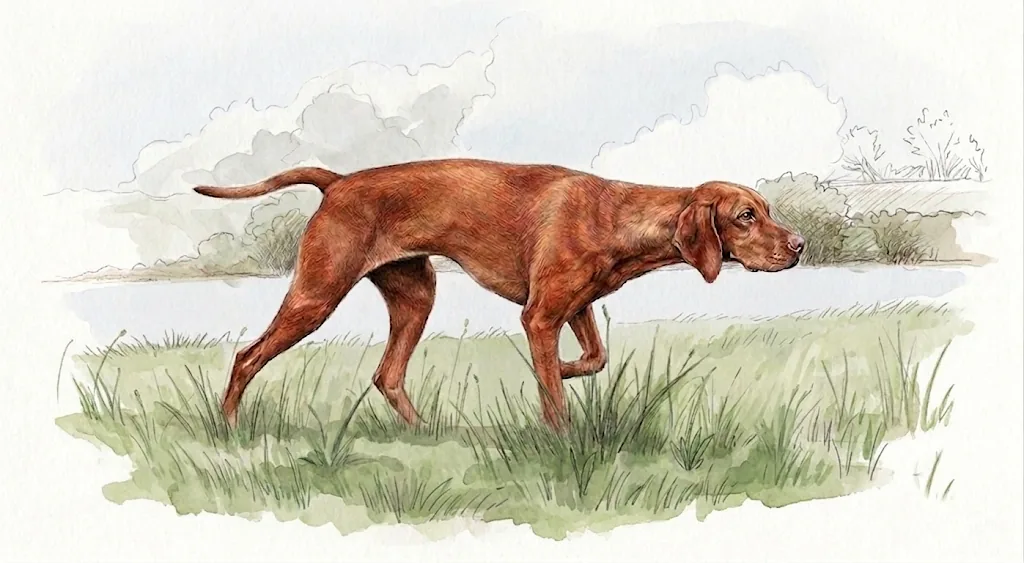
The vizsla in profile. Lean, muscular and "dry", with a level topline, a moderately arched neck and the self-coloured golden-rust coat the official standard requires.
History
Origins
The vizsla's ancestors are traditionally identified with the hunting dogs that accompanied the Magyar tribes into the Carpathian Basin in the ninth and tenth centuries. Early evidence is iconographic rather than documentary: a fourteenth-century illumination in the Chronicon Pictum (Vienna Illuminated Chronicle) is often interpreted as showing a falconer accompanied by a dog of vizsla-like type. Over the following centuries the yellow pointing dog of the Hungarian plains was refined by the landed nobility, who prized it for work on partridge, quail and hare in the wheat fields of the puszta.
The Hungarian word vizsla is generally rendered as "searcher" or "tracker", from a root meaning to seek or examine, and appears in Hungarian documents from the early sixteenth century in connection with hunting dogs. In Hungary the breed is formally the rövidszőrű magyar vizsla — the "short-haired Hungarian vizsla" — distinguishing it from the wire-haired breed developed in the 1930s.
The breed's exact genetic make-up is uncertain. Writers have proposed contributions from dogs brought during the Ottoman occupation, from the Transylvanian Hound, and — in the nineteenth century — from imported English pointers and German bird-dogs; the golden colour, however, bred true throughout.
Near-extinction and revival
By the end of the First World War the true vizsla type had been diluted almost out of existence by crossing with imported pointers and setters. A concerted rescue effort in the 1920s located a small number of dogs — about a dozen are commonly cited — that still carried the correct type, and from these the modern stud book was re-established. The Fédération Cynologique Internationale accepted the breed in 1936. The Second World War and the Soviet period that followed devastated the breed a second time in its homeland; many of the best dogs survived only because fleeing owners took them abroad.
"The vizsla owes its survival twice over to the devotion of individual breeders — first those who rebuilt it from remnants in the 1920s, and then the émigrés who carried it out of Hungary in their arms." — Gay Gottlieb, The Hungarian Vizsla (1985)
The vizsla abroad
Refugee and smuggled dogs founded the breed in Austria, Germany, Italy and beyond. The first vizslas reached the United States in the early 1950s; the Vizsla Club of America was formed in 1953, and the American Kennel Club recognised the vizsla in 1960 as its 115th breed. The breed established itself in Britain in the post-war decades and reached Australia in 1973, where it is judged in the Gundog group under the FCI-derived standard. Today the vizsla ranks among the more popular sporting breeds in the English-speaking world, aided by its suitability as a family companion and running partner.
- The vizsla's nose, eye rims and nails harmonise with the coat in shades of russet gold — black pigmentation is not characteristic of the breed.
- By the traditional account, the modern breed was rebuilt in the 1920s from roughly a dozen surviving dogs of true type.
- In 2000 a vizsla named Chartay became the American Kennel Club's first quintuple champion, titled in five different sports.
- Vizslas have no undercoat, which is why they famously burrow under blankets.
The Vizsla in Australia
Foundation: 1973–1979
The breed reached Australia in 1973, when Frank and Eva Mayhew of Riverstone, New South Wales, imported the bitch Galfrid Fecske (whelped 1971) from Angela Boys's Galfrid kennel in England. The first male, Ch Galfrid Lott CD, followed from the same kennel in 1974, and together the pair produced the first Australian-born vizsla litter in September 1974. The Mayhews bred on under the Kingsbury prefix, and the Hungarian Vizsla Club of NSW still awards the Galfrid Fecske Memorial Trophy in memory of the first import.
"In 1973 Galfrid Fecske was the first Hungarian Vizsla imported and registered in Australia." — Hungarian Vizsla Club of NSW, VizslaViews
That single founding pair casts an extraordinarily long shadow: a 40-year retrospective published by the NSW club in 2017 found that over 98 per cent of all litters registered in 2013 still traced back to Fecske and Lott, and that across 1974–2013 only 65 imported or foreign-born vizslas were ever used for breeding. The first generation of kennels beyond Kingsbury included Hanafor (established 1977), Aranyoz and Berki, drawing on further imports from British kennels such as Galfrid, Abbeystag, Russetmantle and Mindenday. A parallel thread ran through New Zealand: dogs from Nan Janssen's Zigeuner kennel entered Australian pedigrees from the mid-1970s, noted in club histories for their finer bone than the earlier British imports.
The quarantine bottleneck
Why a British foundation for a Hungarian breed? For most of the twentieth century Australia's quarantine regime under the Quarantine Act 1908 made dog imports practical only from rabies-free countries — in effect the United Kingdom, Ireland and New Zealand — so continental Hungarian bloodlines were out of reach. The Australian Quarantine and Inspection Service was formed in 1986, and a 1993 review led to the pivotal reform: Animal Quarantine Policy Memorandum 1995/68, issued in November 1995, introduced a country-category system that for the first time admitted vaccinated, titre-tested dogs from approved rabies-affected countries, including continental Europe. Direct Hungarian imports — by live dog and by frozen semen, whose import conditions were aligned in 1997 — became feasible only then. Post-entry quarantine was cut to a ten-day minimum in 2014, and conditions were tightened again in 2023; Hungary is today an approved Group 3 country.
Standard, clubs and the show ring
The vizsla is judged in Dogs Australia (ANKC) Group 3, Gundogs — and, counter-intuitively for a population founded from Britain, under the FCI country-of-origin standard: FCI Standard No 57 (1996), adopted in Australia from 1 January 1998 and revised May 2001. The Hungarian Vizsla Club of Victoria was established in Melbourne in 1988 and held its first championship specialty in 1992; the Hungarian Vizsla Club of NSW, formerly the Vizsla Fanciers Club, formed in 1990. A postal club is reported as early as 1978, though the record is thin.
In the ring and the field, Australia's first Dual Champion — titled in both show and field — was DC Mindenday Zsa Zsa (Imp UK) in 1984, and its first Triple Champion, Tri Ch Hanafor Miss Wickford, followed in 1996. The Rozsda Catharina Memorial Trophy, the national conformation pointscore, has been awarded since 1990–91. The breed's most famous Australian-bred dog is Aust/Eng Ch Hungargunn Bear It'n Mind ("Yogi"), bred in Sydney by Naomi Cragg, who took Best in Show at Crufts in 2010 — the first vizsla ever to win it. The wire-haired vizsla arrived later still: the first reached Australia in 2004, and the ANKC recognised the breed from January 2007 — at which point exactly one dog stood in the country.
National registrations tell the story of the breed's rise: around 110 a year in the mid-1980s, tripling by the late 1990s after the 1995 import liberalisation, climbing through the 2010s to a peak of 816 in 2021–22 and settling to 610 in 2025. Zafyre Vizslas is an ANKC-registered Vizsla breeder in Victoria breeding within this population; profiles of our Vizslas and enquiries about Vizsla puppies are available elsewhere on this site.
of all litters registered in 2013 trace back to Galfrid Fecske and Galfrid Lott.
Description
Appearance
The vizsla is a medium-sized, short-coated gundog of distinguished, elegant bearing — lean, muscled and "dry", without exaggeration of bone or skin. The FCI standard calls for dogs of 58–64 cm (23–25 in) at the withers and bitches of 54–60 cm (21–23½ in); the standard specifies no weight, but adults typically weigh 20–27 kg (44–60 lb; 3 st 2 lb – 4 st 4 lb). The head is noble and moderately wide, the muzzle blunt rather than pointed, the ears thin, silky and hanging close to the cheeks. Eyes are a shade darker than, and harmonising with, the coat. The gait is far-reaching, light and driving — the movement of a galloping field dog rather than a trotting show dog.
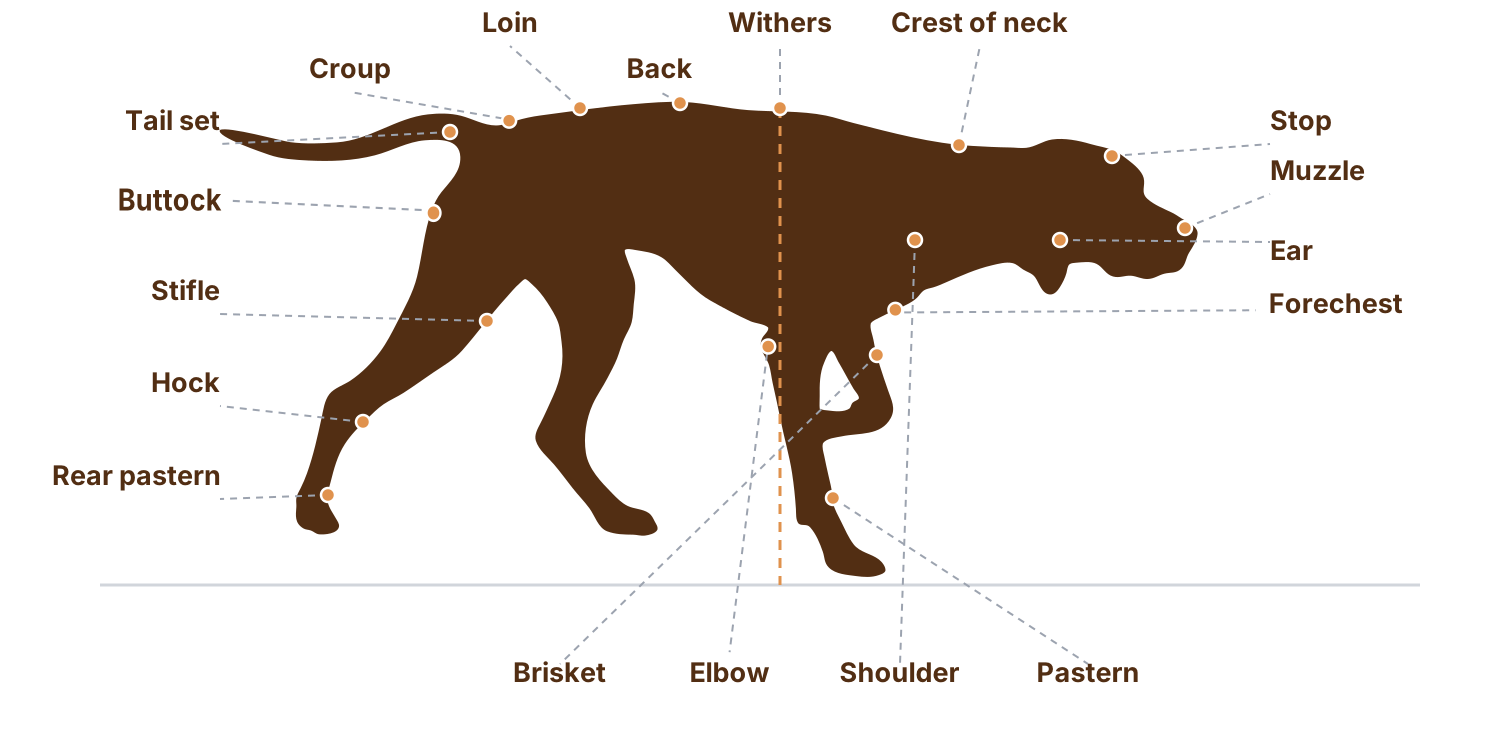
Points of the vizsla. The anatomical landmarks named in the breed standard. Height is taken at the withers, the ridge between the shoulder blades; the dotted line marks that measurement.
Coat and colour
The coat is short, straight, dense and close-lying, with no undercoat — a point of practical consequence, since the breed feels cold and wet keenly and is not suited to living outdoors. The colour is the breed's signature: a self-coloured golden rust ("russet gold"). Under the standard the nose harmonises with the coat in a somewhat darker shading, the lips and eye rims correspond with the nose, and the nails are brown. Dark mahogany red and pale yellow are faulted; small white marks on the chest or toes are tolerated but not desired. Black pigmentation is not characteristic of the breed — coat and visible pigmentation should harmonise in shades of russet gold, a point that distinguishes the vizsla from superficially similar breeds.
Coat colour. The standard's permitted range of golden rust, with the two commonly faulted extremes marked. Colours are indicative rather than a calibrated reference.
Temperament
The standard describes the vizsla as lively, gentle-mannered and demonstrably affectionate, with a strongly developed trainability and an inability to bear rough treatment. The breed forms strong, lasting bonds with its household and thrives on being included in the day’s work and family life. It is a sensitive, soft-tempered dog that responds to positive training methods and wilts under harsh ones. Properly exercised and included in family life, it is calm indoors; under-stimulated, it is famously inventive in its mischief.
Health
The vizsla is regarded as a generally healthy sporting breed that commonly lives into its early teens; breed organisations generally quote around 10–14 years, though population studies vary. The UK Kennel Club's Breed Health and Conservation Plan (2022) and breed-club health programmes identify the conditions of principal concern as hip dysplasia, idiopathic epilepsy, certain cancers (notably lymphoma and mast cell tumours), sebaceous adenitis, and the immune-mediated muscle disease polymyositis, which has been the subject of UK research in the breed. Reported prevalence varies between surveys, and most individual dogs are never affected by any of them. Responsible breeders screen breeding stock through hip-scoring schemes and follow breed-club health protocols. Because the breed carries no undercoat and little body fat, it needs protection in cold, wet conditions.
Care and exercise
The vizsla is a high-energy athlete bred for a full day's work and requires substantial daily physical exercise and mental stimulation; needs vary by age and individual, but this is a working breed for which a short daily walk is generally insufficient. Grooming needs are minimal: the short coat sheds lightly and is kept in condition with occasional rubber-brushing. The breed is a natural swimmer and takes readily to water work. Vizslas are generally good with children and other dogs but, as bird-dogs, may not be trustworthy with pet birds; early socialisation is recommended as for all gundogs.
In sport and work
As an HPR breed the vizsla competes in field trials, hunt tests and working gundog assessments, and has a celebrated record of dual champions — dogs titled in both the show ring and the field — a distinction often taken as evidence that its working and show types have not diverged. Beyond the field, vizslas compete successfully in agility, obedience, tracking, canicross and barn hunt, and serve as therapy, search-and-rescue and detection dogs.
In 2000 a vizsla bitch known as Chartay became the first dog of any breed to earn championship titles in five separate American Kennel Club sports, making her the AKC's first quintuple champion.
- FCI: Group 7 (Pointing Dogs), Section 1.1 Continental Pointing Dogs, with working trial.
- Dogs Australia (ANKC): Group 3, Gundogs.
- AKC: Sporting Group; eligible for pointing-breed field trials and hunt tests.
Eleven Centuries in Twenty-Five Moments
From the Magyar migration to two near-extinctions and a worldwide recovery. Search the record, filter by era or theme, or take the guided tour.
Dates before the twentieth century are necessarily approximate, and the earliest are traditional attributions rather than documented fact — the editor's notes flag the contested ones.
How the Vizsla Reached the World
An animated history of the journey from the plains of the Carpathian Basin to the wider world — carried west by war, then across oceans by enthusiasts. Press play, drag the map, or click any milestone.
{{ mapPlace }}{{ mapCountry }}
{{ mapText }}
Reference
Glossary
- Conformation
- The structure, shape and arrangement of a dog as judged against its official breed standard; also shorthand for shows in which dogs are judged on these traits.
- Dual champion
- A dog that has earned championship titles in both conformation and field trials. The vizsla is noted for producing an unusually high number of dual champions among sporting breeds.
- Field trial
- A competitive event that tests a gundog's hunting ability under formal rules — steadiness, pointing, retrieving and handling response.
- Gundog (sporting group)
- The group of breeds developed to assist hunters of game birds: pointers, setters, retrievers, spaniels and the versatile (HPR) breeds.
- HPR
- "Hunt, Point, Retrieve" — the British and Australian designation for versatile continental gundog breeds, including the vizsla, that perform all three roles in the field.
- Pointing
- The instinctive frozen stance — nose extended, tail level, often one forefoot raised — by which a bird-dog indicates the location of hidden game to the hunter.
- Retrieve to hand
- Delivery of shot game directly to the handler's hand without dropping, a hallmark of a finished gundog.
- Self-coloured
- Having a coat, nose, eye rims, lips and nails of a single blended colour tone, as required by the vizsla standard (golden rust).
- Stud book
- The official registry of a breed's pedigrees maintained by a kennel club; the modern vizsla stud book was re-established in Hungary in the 1920s.
- Versatile hunting dog
- A breed expected to work fur and feather on land and in water — hunting, pointing, tracking and retrieving — rather than specialising in one task.
- Withers
- The ridge between a dog's shoulder blades; the point at which height is measured.
Frequently asked questions
- When did Hungarian Vizslas come to Australia?
- Hungarian Vizslas came to Australia in 1973, when the bitch Galfrid Fecske was imported from England by Frank and Eva Mayhew of Riverstone, New South Wales. The first male, Ch Galfrid Lott CD, followed in 1974, and the first Australian-born litter was whelped in September 1974.
- Are Vizslas recognised by the ANKC?
- Yes. The Hungarian Vizsla is recognised by the Australian National Kennel Council, trading as Dogs Australia, and is judged in Group 3, Gundogs. Australia applies FCI Standard No 57, adopted from 1 January 1998 and revised in May 2001.
- Where does the Vizsla breed originate?
- The vizsla originates in Hungary, in the Carpathian Basin. Its ancestors are traditionally identified with the hunting dogs of the Magyar tribes who settled the region in the ninth and tenth centuries.
- Why do Australian Vizslas descend from British rather than Hungarian dogs?
- Australian quarantine rules permitted dog imports in practice only from rabies-free countries, so the breed was founded here from British kennels. Direct imports from continental Europe became possible only after Animal Quarantine Policy Memorandum 1995/68 took effect in November 1995.
- How many Hungarian Vizslas are registered in Australia?
- National registrations ran at about 110 a year in the mid-1980s, tripled by the late 1990s, peaked at 816 in 2021–22 and settled to 610 in 2025, according to Dogs Australia registration analysis.
Sources
- FCI-Standard N° 57: Hungarian Short-haired Pointer (Vizsla) — Rövidszőrű Magyar Vizsla. Thuin, Belgium: Fédération Cynologique Internationale.
- "Vizsla Dog Breed Information". American Kennel Club.
- Gottlieb, Gay (1985). The Hungarian Vizsla. Hampshire: Nimrod Press. pp. 11–24.
- Coffman, Marion I. (2004) [1992]. Versatile Vizsla (2nd ed.). Loveland, CO: Alpine Publications. pp. 3–9.
- Breed Health and Conservation Plan: Hungarian Vizsla (Report). London: The Kennel Club. 2022.
- "Vizsla health". Hungarian Vizsla Club (UK).
- "Hungarian Vizsla Breed Standard". Dogs Australia (Australian National Kennel Council).
- Boggs, Bernard C. (2000). The Vizsla. Ohio: Glenbrier Publishing. pp. 31–47.
- Chronicon Pictum (Vienna Illuminated Chronicle), c. 1358. Reproduced in Gottlieb (1985), p. 13.
- "History of the Vizsla". Vizsla Club of America.
- FCI-Standard N° 239: Hungarian Wire-haired Pointer (Drótszőrű Magyar Vizsla). Thuin, Belgium: FCI.
- "Vizsla Dog Breed Health and Care". PetMD.
- Orzeszko, A. (2017). "40 Years of Hungarian Vizsla Breeding in Australia". VizslaViews 2017-4. Hungarian Vizsla Club of NSW.
- Department of Agriculture (2013). Final Policy Review — Importation of Dogs and Cats. Canberra: Commonwealth of Australia.
- "National Animal Registration Analysis, 1986–2025". Dogs Australia (Australian National Kennel Council).
- Donath, Otto. "Flüchtlinge und Vertriebene (Refugees and Expellees)," 1946. German Federal Archives (Bundesarchiv), Bild 146-1978-063-29A. Available via Wikimedia Commons. Licensed under CC BY-SA 3.0. [Image modified to a colorized sketch format.]
- Wikipedia contributors (2026). "Royal Palace of Gödöllő". Wikipedia, The Free Encyclopedia. Wikimedia Foundation. en.wikipedia.org/wiki/Royal_Palace_of_Gödöllő.
- Wikimedia Commons contributors (2026). "Category: Royal Palace of Gödöllő". Wikimedia Commons. Wikimedia Foundation. commons.wikimedia.org/wiki/Category:Royal_Palace_of_Gödöllő.
Further reading
- American Kennel Club (2006). The Complete Dog Book (20th ed.). New York: Ballantine Books.
- Cunliffe, Juliette (2004). The Encyclopedia of Dog Breeds. Bath: Parragon Publishing.
- Gottlieb, Gay (1985). The Hungarian Vizsla. Hampshire: Nimrod Press.
- The Kennel Club (2022). Breed Health and Conservation Plan: Hungarian Vizsla. London: The Kennel Club.